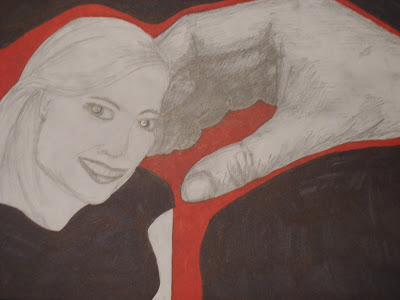
this art journal thing is pretty awesome. i'm really enjoying myself.
found this quote on pinterest...turned it into my own work of art. i like this...it's good to remember. the hard times, the scary things, the unknown--they all lead to the good things in life. new experiences, new people, new chances to learn.
another idea from pinterest--these are my children's hands. optical illusion....they bring color and life and a thousand shades of emotion to my life.
and this one is just self-explanatory. :)
anyone else out there use an art journal?
my journey through life, surviving childhood sexual abuse, bipolar disorder and PTSD
Showing posts with label emotion. Show all posts
Wednesday, February 20, 2013
Wednesday, June 23, 2010
expressive arts carnival activity number 1
i stumbled across an expressive arts carnival today at mind parts. this activity is right up my alley...and i really wanted to participate in this carnival. each month, there will be a new creative activity. this is the first month--and the first activity is to create a wordle or other word cloud to captures the essence of a soothing activity.
for me this wasn't even a question. art. art is what brings me peace in expression. art is what allows me to release and express my thoughts and emotions when words fail. drawing, painting, even something as simple as using crayons in a coloring book brings me such childlike joy, such satisfaction. i would be lost inside my own head without my art.

Wednesday, January 27, 2010
cracked: understanding why i act the way i do
hubby and i love to watch reality tv.
one of the shows we really enjoy is "celebrity rehab with dr. drew" on vh1. we also watched the "sex rehab" show that just ended. for those of you who don't know about the show, it follows a group of celebrities living in an actual rehab facility as they detox from various chemical addictions. (in the case of sex rehab, they were sex addicts.)
hubby really likes dr. drew pinsky, as do i. hubby first knew of him from listening to "loveline" on the radio. while i have listened to "loveline" a few times, it's from these shows that i really saw who he was. a doctor who really cares about his patients and tries to educate the world about trauma and addiction.
watching the series sex rehab really struck a chord with me. i am not, and never have been, an addict of any kind. i do have something in common with all of these people, though: childhood trauma. i probably would make a very good addict, if i had ever chosen to get into drugs or alcohol. lucky for me i never did.
every week hubby and i watched as these people battled with their inner demons, their past experiences, and their fears. nearly every single person on that show had been sexually abused. one particular episode stuck out to me. on this episode, the patients were taken to a facility for some art therapy. once they arrived, they were given the opportunity to throw paint-filled balloons, eggs, and dishes at a very large canvas hung on the wall. they were there to explore and express their anger in a therapeutic setting. by the end of the episode i was in tears. that was me. those people...they were me. they were just like me.
recently i started reading a book written by dr. drew, called "cracked: putting broken lives together again: a doctor's story." while this book is specifically about addicts and their rehab process, i have found much of it applies to me as a survivor of abuse. it has been very interesting to me to read it, and i wanted to pass the recommendation on to my fellow survivors, whether or not you struggle with some form of addiction. and to everyone else, it's a great book to read.
while reading it the other night i came across a passage and had a sort of epiphany. i have always struggled with handling my emotions (especially anger and frustration) in a health and appropriate way. this passage from "cracked" really stood out to me, because it was describing me perfectly. i'd like to share that with you, maybe it will make sense to some of you out there as well. this section is taken from a lecture that dr. drew gave to some of his former patients and their families. (it is a little long, but trust me, it's worth reading. i promise.)
"You want to know the common denominator among my patients?" I say, turning serious. "They all had traumatic experiences in early life that caused them to feel helpless, powerless, and in grave danger." I see some people nodding. "This feeling of helplessness creates an inability to process feelings and an aversion to exploring other minds. There's no trust. If you can't trust, you can't connect with anyone. Without the capacity to activate the part of the brain that allows for connection and exploration of other people, an individual loses the main mechanism for discovering who we are and the ability to regulate emotions.
"Think about it," I continue. "For all of us, other people function as self-regulating agents. We learn to identify ourselves when we recognize ourselves in others. We constantly think, 'Oh, that's exactly how I feel.' Or you say, 'I was thinking that exact same thing.' Our experiences of ourselves become internalized as a result of this sort of interaction. We figure out who we are.
"But my patients--many of you--automatically take the emotional posture that the abuse you fell victim to was your fault. Why? Because at least then you avoid feeling the threat of the contents of the mind of your abuser. You don't ask why Daddy hits you or Mommy's passed out on the living room floor. If it's your fault, you're more in control.
"You're sacrificing yourself in order to maintain the illusion of control in a situation that otherwise you'd experience as irrational and unpredictable. Of course, if you're at fault, you're also feeling shame. In addition, your brain kicks into an automatic biological response that becomes a permanent mechanism for dealing with interpersonal stress. This is the action your brain takes to escape these situations from which there's no escape, something called dissociation."
A gray-haired man in mechanic's coveralls raises his hand. I have treated him and his son.
"So what are you saying that I'm feeling?" he asks.
"What did I say all my patients have in common?"
"Helplessness," he ays.
"What do you feel when you're helpless?" I ask.
"Fear," he says.
"Right. The initial response to threat is fear. How does this happen? Well, chemicals flood into the brain as the flight-or-fight response is initiated. When escape seems hopeless, your brains switches into shut-down mode, releasing a flood of endorphins that provide a soothing numbness as you wait for the inevitable to occur.
"The experience that predominates this reaction is what?"
I call on a young guy seated on the side.
"I don't even get what you're saying," he says. "But I'm guessing that it's the sense that you're somewhere else, gone, shut down."
"Exactly," I say. "Dissociation. You separate and isolate yourself from the world, from feelings, from others. While such a reaction may protect you from the horrifying experience--whatever that turns out to be--the price is a long-term difficulty in integrating emotional experiences. Think back to whatever age you suffered trauma. That's when you shut down. That's when you decided you were to blame. That's when you stopped developing and growing in the part of the brain that regulates emotions. That's when you stopped connecting with others.
"So what happens? The personality that accompanies you as you mature physically tends to have a hard time in relationships. In fact, the original victimization is often recreated over and over again. It's the same problem repeated, and more problems ensue. You can't trust someone with your tender needs in a genuine relationship. Why? It's too dangerous. It's too likely to expose you to trauma again....
"So your ability to develop brain mechanisms to regulate emotions is impaired, since we tend to build these through intimate connections with others. It's a great big mess that causes you to enter your young life looking for solutions to those feelings of being, as most of you say, screwed up. You aren't able to find any peace until you find drugs or alcohol. Then, suddenly, for the first time, everything seems all right."
wow. talk about a profound insight....no wonder i act like i'm six years old when things get tough...it's that fight-or-flight, and that is also why i struggle with conflict in relationships, especially those who are closest to me.
for me, as i said, it isn't drugs or alcohol that makes me feel like everything is all right. i rarely feel that way, in fact. i've had moments of it, though. like when my husband holds me close and lets me cry it out, telling me that he loves me and that it will be okay, that he's there for me. when i hold my sweet babies. when my son says "mommy" and lays his head on my shoulder. when my daughter smiles that giant toothless grin at me. in my art. at times in my religion.
understanding why it is i act the way i do makes it easier for me to know where to start in changing it. changing it is the hard part...i am embarking on a long and painful journey, and at least i know a little better where i'm starting from.
and as a side note, i wish i had lots of money so dr. drew could be my therapist.
cracked, copyright 2003 by dr. drew pinsky
one of the shows we really enjoy is "celebrity rehab with dr. drew" on vh1. we also watched the "sex rehab" show that just ended. for those of you who don't know about the show, it follows a group of celebrities living in an actual rehab facility as they detox from various chemical addictions. (in the case of sex rehab, they were sex addicts.)
hubby really likes dr. drew pinsky, as do i. hubby first knew of him from listening to "loveline" on the radio. while i have listened to "loveline" a few times, it's from these shows that i really saw who he was. a doctor who really cares about his patients and tries to educate the world about trauma and addiction.
watching the series sex rehab really struck a chord with me. i am not, and never have been, an addict of any kind. i do have something in common with all of these people, though: childhood trauma. i probably would make a very good addict, if i had ever chosen to get into drugs or alcohol. lucky for me i never did.
every week hubby and i watched as these people battled with their inner demons, their past experiences, and their fears. nearly every single person on that show had been sexually abused. one particular episode stuck out to me. on this episode, the patients were taken to a facility for some art therapy. once they arrived, they were given the opportunity to throw paint-filled balloons, eggs, and dishes at a very large canvas hung on the wall. they were there to explore and express their anger in a therapeutic setting. by the end of the episode i was in tears. that was me. those people...they were me. they were just like me.
recently i started reading a book written by dr. drew, called "cracked: putting broken lives together again: a doctor's story." while this book is specifically about addicts and their rehab process, i have found much of it applies to me as a survivor of abuse. it has been very interesting to me to read it, and i wanted to pass the recommendation on to my fellow survivors, whether or not you struggle with some form of addiction. and to everyone else, it's a great book to read.while reading it the other night i came across a passage and had a sort of epiphany. i have always struggled with handling my emotions (especially anger and frustration) in a health and appropriate way. this passage from "cracked" really stood out to me, because it was describing me perfectly. i'd like to share that with you, maybe it will make sense to some of you out there as well. this section is taken from a lecture that dr. drew gave to some of his former patients and their families. (it is a little long, but trust me, it's worth reading. i promise.)
"You want to know the common denominator among my patients?" I say, turning serious. "They all had traumatic experiences in early life that caused them to feel helpless, powerless, and in grave danger." I see some people nodding. "This feeling of helplessness creates an inability to process feelings and an aversion to exploring other minds. There's no trust. If you can't trust, you can't connect with anyone. Without the capacity to activate the part of the brain that allows for connection and exploration of other people, an individual loses the main mechanism for discovering who we are and the ability to regulate emotions.
"Think about it," I continue. "For all of us, other people function as self-regulating agents. We learn to identify ourselves when we recognize ourselves in others. We constantly think, 'Oh, that's exactly how I feel.' Or you say, 'I was thinking that exact same thing.' Our experiences of ourselves become internalized as a result of this sort of interaction. We figure out who we are.
"But my patients--many of you--automatically take the emotional posture that the abuse you fell victim to was your fault. Why? Because at least then you avoid feeling the threat of the contents of the mind of your abuser. You don't ask why Daddy hits you or Mommy's passed out on the living room floor. If it's your fault, you're more in control.
"You're sacrificing yourself in order to maintain the illusion of control in a situation that otherwise you'd experience as irrational and unpredictable. Of course, if you're at fault, you're also feeling shame. In addition, your brain kicks into an automatic biological response that becomes a permanent mechanism for dealing with interpersonal stress. This is the action your brain takes to escape these situations from which there's no escape, something called dissociation."
A gray-haired man in mechanic's coveralls raises his hand. I have treated him and his son.
"So what are you saying that I'm feeling?" he asks.
"What did I say all my patients have in common?"
"Helplessness," he ays.
"What do you feel when you're helpless?" I ask.
"Fear," he says.
"Right. The initial response to threat is fear. How does this happen? Well, chemicals flood into the brain as the flight-or-fight response is initiated. When escape seems hopeless, your brains switches into shut-down mode, releasing a flood of endorphins that provide a soothing numbness as you wait for the inevitable to occur.
"The experience that predominates this reaction is what?"
I call on a young guy seated on the side.
"I don't even get what you're saying," he says. "But I'm guessing that it's the sense that you're somewhere else, gone, shut down."
"Exactly," I say. "Dissociation. You separate and isolate yourself from the world, from feelings, from others. While such a reaction may protect you from the horrifying experience--whatever that turns out to be--the price is a long-term difficulty in integrating emotional experiences. Think back to whatever age you suffered trauma. That's when you shut down. That's when you decided you were to blame. That's when you stopped developing and growing in the part of the brain that regulates emotions. That's when you stopped connecting with others.
"So what happens? The personality that accompanies you as you mature physically tends to have a hard time in relationships. In fact, the original victimization is often recreated over and over again. It's the same problem repeated, and more problems ensue. You can't trust someone with your tender needs in a genuine relationship. Why? It's too dangerous. It's too likely to expose you to trauma again....
"So your ability to develop brain mechanisms to regulate emotions is impaired, since we tend to build these through intimate connections with others. It's a great big mess that causes you to enter your young life looking for solutions to those feelings of being, as most of you say, screwed up. You aren't able to find any peace until you find drugs or alcohol. Then, suddenly, for the first time, everything seems all right."
wow. talk about a profound insight....no wonder i act like i'm six years old when things get tough...it's that fight-or-flight, and that is also why i struggle with conflict in relationships, especially those who are closest to me.
for me, as i said, it isn't drugs or alcohol that makes me feel like everything is all right. i rarely feel that way, in fact. i've had moments of it, though. like when my husband holds me close and lets me cry it out, telling me that he loves me and that it will be okay, that he's there for me. when i hold my sweet babies. when my son says "mommy" and lays his head on my shoulder. when my daughter smiles that giant toothless grin at me. in my art. at times in my religion.
understanding why it is i act the way i do makes it easier for me to know where to start in changing it. changing it is the hard part...i am embarking on a long and painful journey, and at least i know a little better where i'm starting from.
and as a side note, i wish i had lots of money so dr. drew could be my therapist.
cracked, copyright 2003 by dr. drew pinsky
Sunday, January 18, 2009
because i've been showing off everyone else's art this week
i decided to post some of my own art. these images aren't the best, i just took pictures of them because many are too large to scan.
i would love some feedback...but in a specific way. i'm going to number each one. please leave a comment and tell me one word to describe the feeling/emotion you get when looking at that piece. if you only want to mention one, or two, whichever ones really strike you, that's great. the whole point to my art is to evoke emotion, and to portray the emotions i feel at the time i am producing the art.

i would love some feedback...but in a specific way. i'm going to number each one. please leave a comment and tell me one word to describe the feeling/emotion you get when looking at that piece. if you only want to mention one, or two, whichever ones really strike you, that's great. the whole point to my art is to evoke emotion, and to portray the emotions i feel at the time i am producing the art.
1.
Saturday, January 3, 2009
an untitled emotion?
from the archives of my private blog--sorry all, my depression is kind of kicking my butt lately and i haven't had a whole ton of great things to talk about.
i've always found this painting fascinating. today i feel like this. not sure if it's because of exhaustion, or stress, boredom, depression...
A Bar at the Folies Bergere, 1881-2Edouard Manet
this girl is surrounded by happy, talking, laughing people. she is even talking to someone...or he is talking to her. (as seen in the reflection of the mirror behind her.) and yet...if you look at her face...she is far away somewhere. but what is she thinking? it's interesting to me that depending on my own mood she is thinking about something different almost every time i see it. today she is thinking about how much she hates her job, she is tired and misses her baby, and doesn't feel like being social. or maybe she feels alone in a crowded room. isn't it funny how you can feel that way? to be surround by people, even interacting with those people, and still feel completely alone.
human emotions are so complex. i am frequently confused by my own. wouldn't it be amazing to be able to sort through your own emotions, to be able to put specific names with them, understand why you feel that way, where they come from, make them into logic. i think that is a pretty lofty goal. in my experience people can be divided into a few groups fairly easily. people like me, who are emotional about everything but can usually control their actions. people who cannot control their emotions, and therefore let their emotion control their actions, let them rule their lives. people who shut emotion out completely. people who shut emotions out most of the time and other times have outbursts. and then those who can recognize the emotion and choose how to display it, in appropriate ways. (these are few and far between, i believe.) and then those who have one or two emotions the majority of the time. i float between a few of these 'categories' most of the time.
but the real question is...what is the best way to deal with emotion? and how do you get to that point? does suppressing them until you can be alone to let it out really help? crying all of the time doesn't seem to do much in my experience. i cry when i'm happy, sad, mad, hurt, shocked...you get the point. and i can't seem to control it. trying to stop the tears makes me more upset. i mean, last night i was singing primary songs to my son and started to cry. i can't get more than two lines of "i feel my savior's love" out without my voice cracking.
maybe this is why i love art so much. it is a way for me to express emotion without tears. although, and hubby will attest to this, i cannot enter an art museum without crying at least once. mostly i am so in awe of everything that surrounds me. i could stand in front of a single painting for an hour without moving, probably.
i suppose i am overanalyzing things at this point.
am i the only one that does this?
Monday, December 29, 2008
the story of beatrice cenci
from the archives of my private blog
Beatrice Cenci, 1860
Beatrice Cenci, 1860 Julia Margaret Cameron
Harriet Hosmer
this story is from wikipedia
(born 1577-died 1599) Beatrice was the daughter of Francesco Cenci, an aristocrat who, due to his violent temper and immoral behaviour, had found himself in trouble with papal justice more than once. They lived in Rome in the rione Regola, in Palazzo Cenci, built over the ruins of a medieval fortified palace at the edge of Rome's Jewish ghetto. Together with them lived also Beatrice's elder brother Giacomo, Francesco's second wife, Lucrezia Petroni, and Bernardo, the young boy born from Francesco's second marriage. Among their other possessions there was a castle, La Rocca of Petrella del Salto, a small village near Rieti, north of Rome.
According to the legend, Francesco Cenci abused his wife and his sons, and had reached the point of committing incest with Beatrice. He had been jailed for other crimes, but thanks to the leniency with which the nobles were treated, he had been freed early. Beatrice had tried to inform the authorities about the frequent mistreatments, but nothing had happened, although everybody in Rome knew what kind of person her father was. When he found out that his daughter had reported against him, he sent Beatrice and Lucrezia away from Rome, to live in the family's country castle. The four Cenci decided they had no alternative but to try and get rid of Francesco, and all together organized a plot. In 1598, during one of Francesco's stays at the castle, two vassals (one of whom had become Beatrice's secret lover) helped them to drug the man, but this failed to kill Francesco. Following this Beatrice, her siblings and step mother bludgeoned Francesco to death with a hammer and threw the body off a balcony to make it look like an accident. No one believed the death to be an accident.
Somehow his absence was noticed, and the papal police tried to find out what had happened. Beatrice's lover was tortured, and died without revealing the truth. Meanwhile a family friend, who was aware of the murder, ordered the killing of the second vassal, to avoid any risk. The plot was discovered all the same and the four members of the Cenci family were arrested, found guilty, and sentenced to death. The common people of Rome, knowing the reasons for the murder, protested against the tribunal's decision, obtaining a short postponement of the execution. But pope Clement VIII showed no mercy at all: on September 11, 1599, at dawn, they were taken to Sant'Angelo Bridge, where the scaffold was usually built. Giacomo was quartered with a mallet and had his limbs hung in the four corners; then Lucrezia and finally Beatrice took their turn on the block, to be beheaded with a sword. Only the young boy was spared, yet he too was led to the scaffold to witness the execution of his relatives, before returning to prison and having his properties confiscated (to be given to the pope's own family). Beatrice was buried in the church of San Petro in Montorio. For the people of Rome she became a symbol of resistance against the arrogant aristocracy and a legend arose: every year on the night before her death, she came back to the bridge carrying her severed head.
such a sad story. got me thinking though...was her crime warranted? her father was doing terrible, unspeakable things to her and her family, but she was still breaking the law in committing murder. or was it self defense? did the pope just want their money? or was he really punishing the crime justly? i love that she became a symbol of resistance for the regular people. i don't know what i would do in her place. if i had had the ability to end my abuse, and if the only way to do so would be to murder my abuser, would i have done it? if it were still going on now, would i kill him? would it be justified?
isn't it awesome what you can learn by looking at a piece of artwork? that is one of my favorite things about art history--you learn so much about the artist, historical facts, legends, controversy in the time period, and the emotional response of not only the artist, but those viewing the art at the time and how it relates to the present viewer and time. my most favorite thing is my personal emotional reaction and being able to relate to something that was meant for people hundreds of years ago. it really makes you think...even though times change, society changes, people change--the fact that something created in the 17th century (or whenever) still elicits the same emotional reaction of people in the 21st century is pretty amazing. the fact that these two separate pieces of art directly relate to me and my life.
do you think the artist knew that while it was being created?
Subscribe to:
Comments (Atom)